From Sentence to Period: For Violin and Piano
This violin and piano duo has binary form AB and is comprised of two contrasting phrases and moment of transition. The first is a sentence with basic idea and motif in C-mixolydian transforming to C-lydian with a repetition that highlights the dominant. The two different pitch systems in the sentence alongside their commonality (six tones) segues to the period phrase in C-lydian mixolydian mode with a final rest to the period.

Piano Trio, RSom
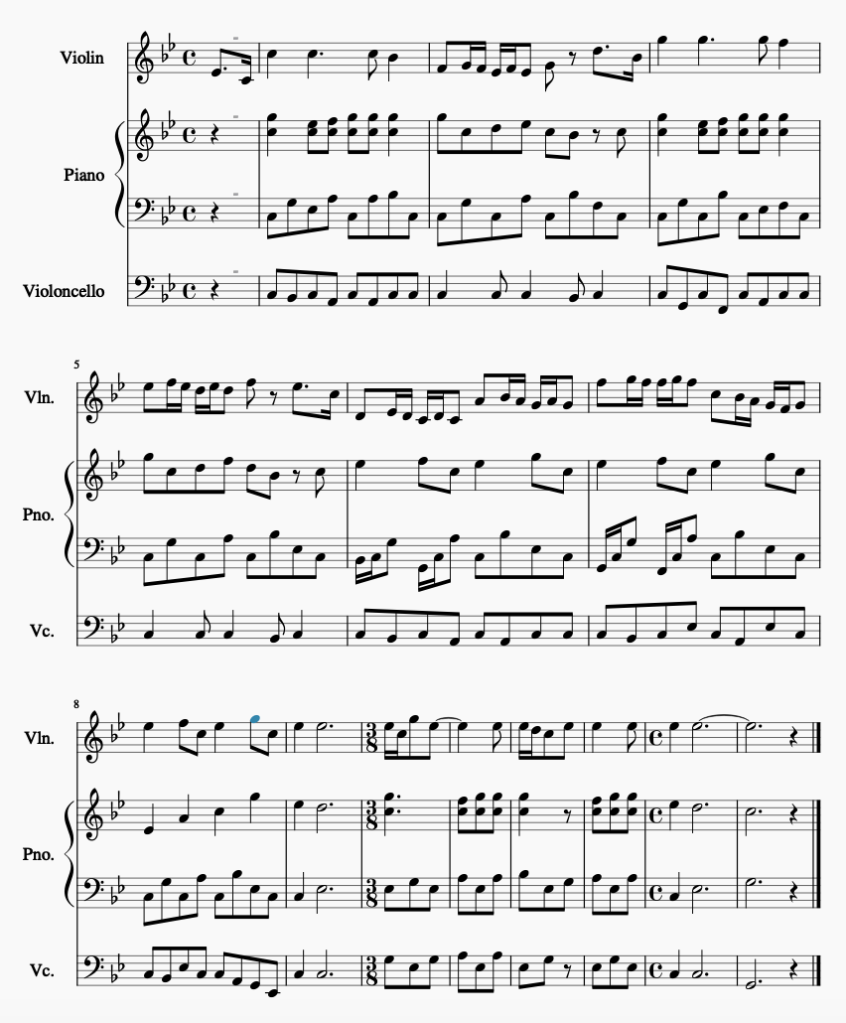
I had the chance to play in a piano trio in high school and we loosely played works by Mozart and Schubert. This piece is inspired by that formative classical ensemble experience I had in high school as well as my Stanford music professor’s, Francois Rose, lecture on melodic and harmonic ambiguity. My composed short piano trio and response to Janacek’s ideas first presents itself as a sentence in common time in C-dorian. It then modulates by changing tonic to E-flat lydian as well as the meter, featuring an accelerando.
12-bar blues
Arabian trio of form ABA’
Here, the first A section has basic idea based on an atonic scale (octatonic mode 1 major-minor) and it contrasts yet shapes the modal B section which is in D-lydian. The A’ section releases with a PAC (perfect authentic cadence).
Individual Electronic Music Composition
above track was made using sounds I recorded (no midi instruments)
Mensuration Canon, Saxophone Quartet
This piece contains mensurations, within each pair, the higher pitched voice having beat of half duration its counterpart; once the canon starts the voices still do not have the same rhythm.
Piano for Human and Future (the) Dog

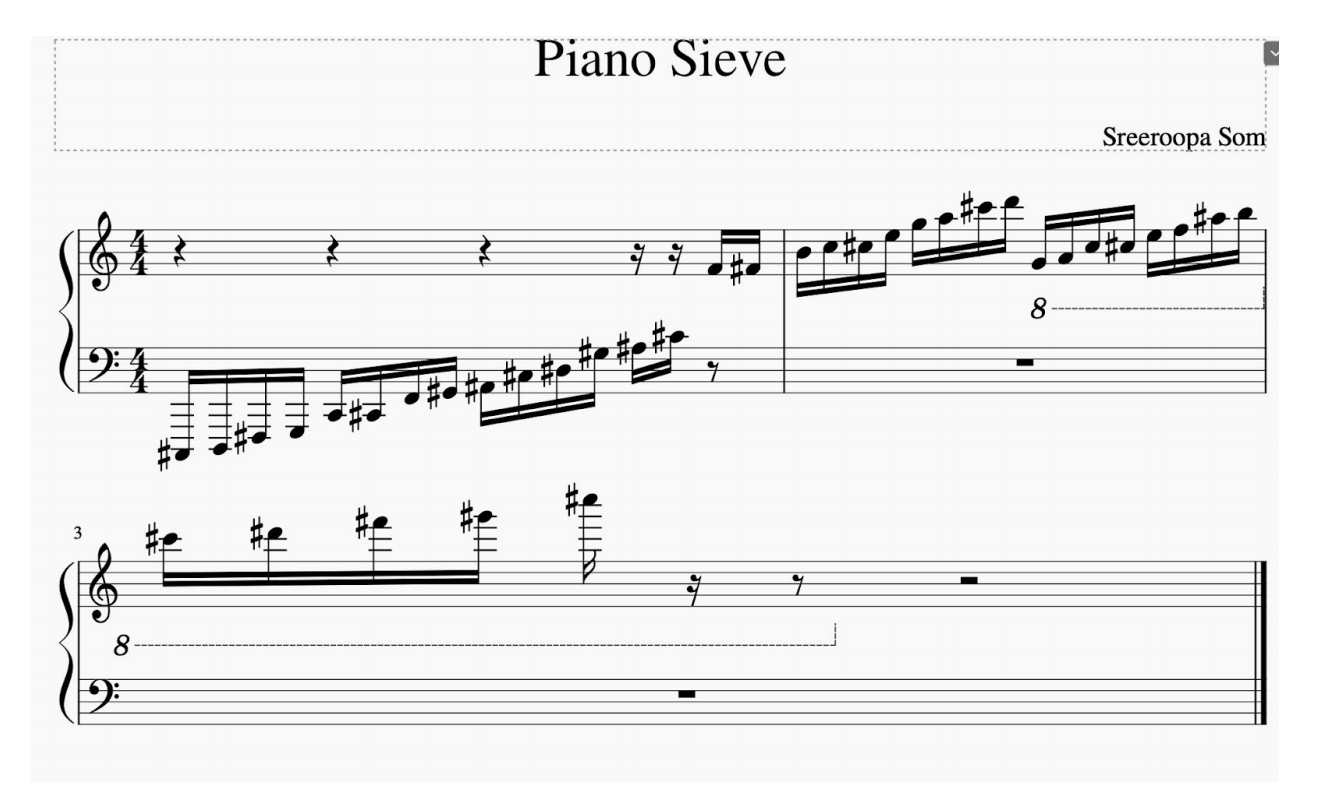
My work here utilizes a sieve (taken from Xenakis’s sieve theory) in period form. Here, pitch rhythm, and form sync with expression to create the illusion of a dog (or any furry creature with paws) aiding a human pianist in reaching the ranges of the keyboard. Below I have included the mathematics of my sieve creation and explanation of my implementation as a period. – work inspired by Francois Rose, Stanford University Music Department Lecturer

Clarinet Quartet: with 4 Variations for Clarinet
With the intent of exploring minimalism, I created a scale of 4 notes to guide my composition: D – E flat – F – G. I then determined the piece to be sectional in nature. I created dynamic contrapuntal sections (variations) each punctuated by a repeating harmonic static texture. Note for each variation: I features unison, in II a 3 against 2 rhythm, III by a double canon and repetition, and IV by a canon.



embellished Ben Suite
My response to Charles Ives‘s “The Unanswered Question”

My response was to create a piano melody with a complex ratio in the left hand, superposing a three part accompaniment (for violin or viola, Bflat trumpet, and tuba) which generates independent pulsations.
A Short Percussive Moment
 roopasom